Reform’s Deliveroo Law:
real problem, but is this really the solution?
Illegal working in food delivery is real. Account sharing is real. Uninsured vehicles and illegally modified e-bikes are real. Reform is right that action is needed. The harder question is whether its headline solution fixes the system or mainly shifts blame after enforcement has already failed.
Illegal working in food delivery is real. Account sharing is real. Uninsured vehicles and illegally modified e-bikes are real. Reform is right that action is needed. The harder question is whether its headline solution fixes the system or mainly shifts blame after enforcement has already failed.
The key issue
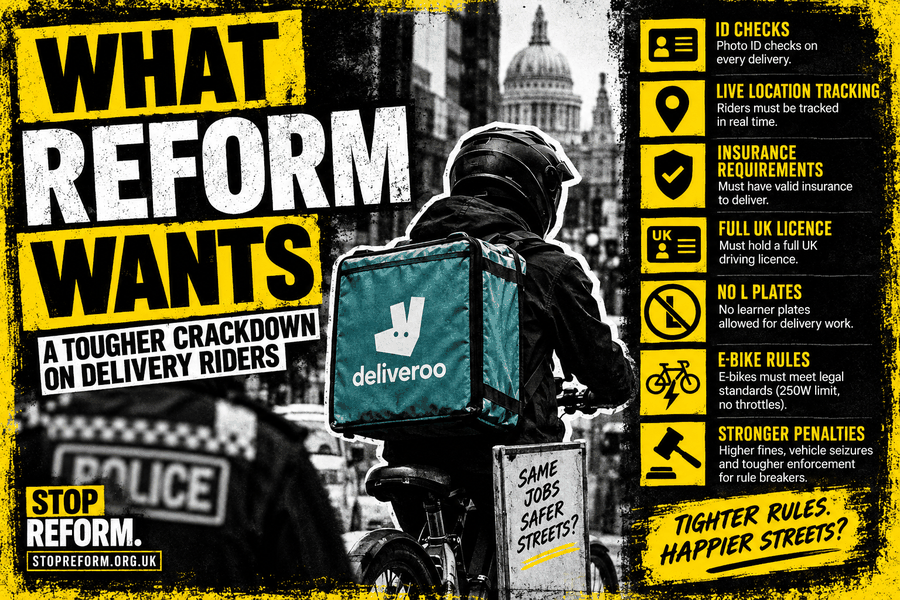
- Reform would make a named UK accountable person criminally liable for systemic illegal working, with up to five years in prison.
- Major firms could face fines of 10% of annual worldwide turnover.
- Commercial delivery drivers and riders would need a full British driving licence.
- Conservative and Labour governments had already identified account sharing and promised stronger checks before Reform announced its plan.
What they said
Reform UK Shadow Home Secretary
Conservative Immigration Minister
The problem was known years ago
In November 2023, Conservative Immigration Minister Robert Jenrick told Deliveroo, Uber Eats and Just Eat to end unchecked substitution. His department said delivery companies did not always know whether the person doing the work had the right to work in Britain. In 2025, Labour announced stronger facial verification, fraud detection and new legal right-to-work duties for gig-economy companies. Thousands of accounts were reportedly removed, yet abuse continued. Reform can fairly say the problem has not been solved. It cannot fairly claim nobody before them noticed it.
Where Reform goes much further
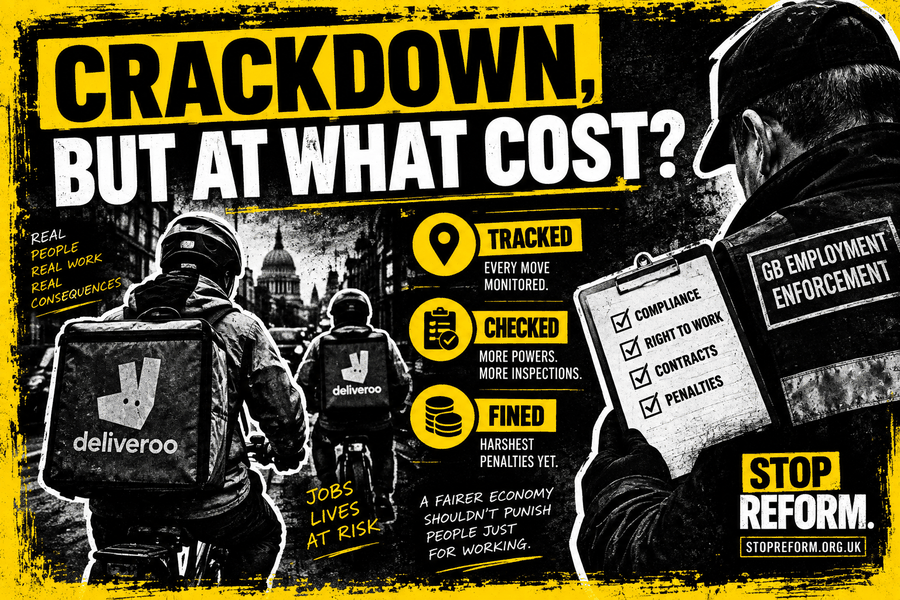
Zia Yusuf's August 2026 proposal would require platforms to designate a UK accountable person. Serious immigration breaches or failure to demonstrate compliant right-to-work checks could expose executives to prison. Major firms could also face fines equal to 10% of worldwide turnover. That is substantial enough to matter to multinational businesses, but criminal liability needs a clear test: who knew, what were they warned about, what power did they have to fix it, and what counts as systemic failure?
The UK director problem
A multinational platform can be owned and controlled overseas while its UK company has replaceable directors. A director cannot erase liability simply by resigning, but prosecuting the name on Companies House does not necessarily reach the person who designed or controlled the failing system. A stronger model would attach responsibility to the company, the accountable senior decision-maker and ultimately the company's right to operate in Britain.
Road safety should be part of this
There is a strong case for requiring anybody commercially delivering by car or motorcycle to have a full UK licence and verified business-use insurance. Commercial delivery on learner plates should end. For e-bikes, current law allows a compliant electrically assisted pedal cycle without registration or insurance, with motor assistance cutting out at 15.5mph. A separate commercial registration and insurance regime could make delivery bikes identifiable without imposing the same system on ordinary cyclists.
Technology can catch what paperwork misses
Delivery apps already know the account identity, device, pickup point, delivery point, route, time and location. They can increase unpredictable identity checks, identify impossible travel patterns, flag repeated device changes, detect implausibly long working hours and preserve evidence of suspected account sharing. Speed alone cannot prove an e-bike is illegal because a legal bike can exceed 15.5mph by pedalling or downhill, but repeated powered-looking high-speed patterns can trigger a proper inspection.
Alternative view: Local People
Stop Reform asked Local People, a new political party being developed, how it would approach the same problem. Local People said platforms should continuously verify that the authorised worker is actually doing the work, verify commercial licences and insurance, automatically flag credible account-sharing patterns and electronically refer suspected illegal working to enforcement. It also argues that every referral should be auditable, including response time and outcome, so government failure cannot be hidden behind another announcement. Local People also says delivery work should become decent, fairly paid work so legal residents, unemployed people and young workers have a realistic reason to choose it. These are Local People proposals, not Stop Reform policy.
Our assessment
Reform has identified a real enforcement failure and some of its proposals, including meaningful corporate fines and ending commercial delivery on provisional licences, deserve serious consideration. But prison for a UK director is not a substitute for competent enforcement, better platform design or accountability for the government agencies that already have powers. The strongest policy would prevent abuse, measure enforcement and punish deliberate repeated failure at the level where decisions are actually made.
Sources
We separate Reform’s own policy and statements from outside reporting and our analysis. Sources checked when this article was prepared.
- Reform UK: Zia Yusuf unveils Deliveroo Law, 6 Aug 2026
- Home Office: Jenrick urges delivery firms to end unchecked account sharing, 14 Nov 2023
- Home Office: delivery firms bolster rider security checks, 30 Jun 2025
- Home Office: operational partnership with delivery giants, 22 Jul 2025
- GOV.UK: electric bike rules